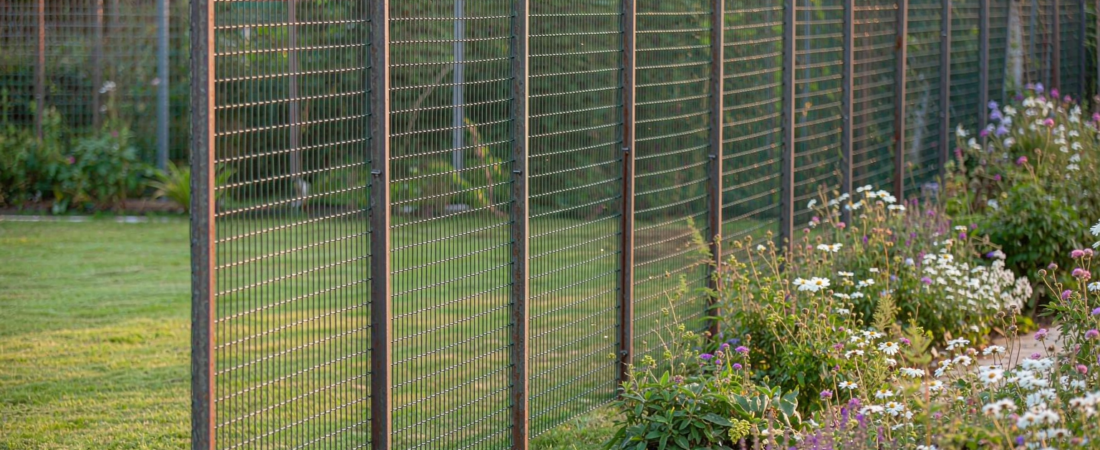
Why Garden Fencing Deserves More Thought Than You Think
Most garden fences are bought in a hurry, usually after a boundary dispute, a new puppy, or a row of seedlings gets flattened. The result is a fence that solves today’s problem and creates three more: sagging posts, rust at the welds, and a look that ages badly against the rest of the garden. This guide walks through the decisions in the order that matters, so the fence you install is still doing its job a decade from now.
Start With What the Fence Has to Do
Before comparing materials, define the job. A garden fence usually has to solve one or more of the following:
- Boundary marking — a clear property line that stays visible through weather and seasons.
- Containment — keeping pets and children in, or keeping deer and rabbits out.
- Security — making casual intrusion inconvenient enough to be pointless.
- Privacy and screening — interrupting sightlines from the street or a neighbouring plot.
- Wind protection — reducing wind damage to vegetables, young trees, and greenhouse frames.
- Structure and aesthetics — defining beds, paths, and the visual rhythm of the garden.
Few fences do all six well. Write down your top two requirements and let them drive everything else: mesh size, height, finish, and budget.
The Main Types of Garden Fencing
Welded Wire Mesh Fencing
Wire mesh is welded at every intersection, which gives it a rigid panel with no slack to sag. It is the most versatile option for gardens: small apertures keep rabbits out, taller panels provide boundary security, and the open structure lets light through so it does not shade the beds. Because the panels are uniform, installation is predictable and the finished line looks deliberate. The main variables are wire diameter, mesh aperture, and coating.
Chain Link Fencing
Woven rather than welded, chain link is cheaper per metre and forgiving of uneven ground, which makes it popular for large plots and temporary boundaries. The trade-off is appearance: it reads as industrial rather than garden. PVC-coated chain link in green or black softens the look considerably and is the usual compromise when budget matters more than design.
Decorative Steel and Tubular Fencing
Palisade and tubular systems are designed to be looked at. They are the right choice for a front garden where the fence is part of the elevation, and they resist climbing better than mesh. They cost more, need more careful setting out, and offer little wind permeability. A dense run of bars behaves like a solid wall in strong wind, so posts and footings must be sized accordingly.
Gabion and Stone-Filled Fencing
Gabion baskets filled with local stone give a heavy, quiet, architectural boundary that absorbs noise and needs almost no maintenance. They work well on slopes and in retaining situations. They are expensive, slow to fill, and effectively permanent. Treat a gabion wall as a structure rather than a fence.
Timber and Composite Fencing
Timber gives warmth and privacy, and it is the fastest way to screen a garden. It also moves, rots at ground contact, and needs periodic treatment. Composite boards avoid rot but expand and contract with temperature, and they are usually the most expensive per metre. If privacy is the only requirement, timber is still hard to beat on cost.
Material and Finish: Where Longevity Is Decided
Two fences of identical design can differ by fifteen years of service life based on the finish alone.
- Hot-dip galvanizing deposits a thick, metallurgically bonded zinc layer over the whole article, inside and out. It is the standard for anything expected to last outdoors, and the coating thickness, not the presence of a coating, is what determines life expectancy.
- Electro-galvanizing is thinner and more uniform. It looks better and costs less, but it is a finish for sheltered or short-life applications.
- PVC coating over galvanized wire adds a colour layer and a second barrier against moisture. Green and black are the practical choices for gardens, and the coating takes the edge off the wire, which matters around animals.
- Powder coating gives the best colour range and a smooth finish, but it is a surface film. Any chip exposes bare steel, so touch-up matters.
One detail that is almost always overlooked: cut ends. Every panel cut on site exposes untreated steel. Caps, sleeves, or a zinc-rich touch-up on cut wires will add years to a fence for very little money.
Height and Mesh Size: Getting the Numbers Right
Height and aperture do different jobs, and both are usually chosen badly.
- Boundary marking: 1.2 to 1.5 m is the normal residential range, high enough to read as a boundary and low enough not to feel like a prison.
- Pet containment: the aperture matters more than the height. A mesh small enough that a dog cannot get its head through is what actually holds an animal. A tall fence with wide mesh does not.
- Deer: 1.8 m is the practical minimum, and 2.4 m where deer pressure is heavy. Deer judge a fence by height and by whether they can see a landing zone on the far side.
- Rabbits: the fence has to go below ground. A 300 mm skirt turned outward and buried defeats digging far more reliably than extra height above grade.
Installation: The Details That Decide Whether It Lasts
Most fence failures are installation failures, not product failures.
- Post spacing should follow the panel or roll specification. Stretching the spacing to save a post is the most common cause of sagging.
- Footings need depth, not just width. Concrete set below the frost line stops seasonal heave from walking posts out of the ground.
- Tension should be applied evenly along the run using a tension bar or line wire, not by pulling one end and hoping.
- Ground clearance of 25 to 50 mm keeps mesh out of soil moisture while still closing the gap that animals exploit.
- Gates are the weakest point. A gate post carries concentrated load and should be larger and deeper than the line posts. This is the single most common underestimate.
- Corners and ends need bracing, or the whole run will lean toward the tension.
What Drives Cost
Budget differences between quotes for the same fence almost always trace back to these variables: wire diameter and coating thickness, post gauge and whether posts are galvanized, footing depth, number of gates, ground conditions such as slope, rock or existing concrete, and whether the run is straight. Ask for all of them to be specified in writing. A cheaper quote is usually a thinner product.
Maintenance That Actually Matters
- Walk the line twice a year and re-tension where panels have loosened.
- Touch up cut ends and scratches with zinc-rich paint before rust spreads under the coating.
- Keep soil and mulch from piling against the base of posts and panels.
- Clear vegetation that traps moisture against the mesh. This is what corrodes the bottom 200 mm first.
Frequently Asked Questions
How long should a garden fence last?
A hot-dip galvanized welded mesh fence, properly installed, is a twenty-year-plus product. Electro-galvanized or poorly coated alternatives in the same design may need replacement in under ten. The finish, not the design, sets the number.
Is welded mesh better than chain link for a garden?
For most gardens, yes. Welded mesh holds its shape, looks tidier, and comes in apertures small enough to exclude small animals. Chain link wins on cost and on very uneven ground.
Can I install a garden fence myself?
Short straight runs on soft ground are realistic for a confident DIYer. Long runs, slopes, corners and gates are where amateur installs fail, and those are worth paying for.
Do I need planning permission?
Rules vary widely by country and even by municipality, and they usually tighten for front boundaries and corner plots. Check locally before ordering, because permission issues are rarely fixable after installation.
Choosing a Supplier
The useful questions are unglamorous: what is the zinc coating thickness, what is the wire diameter, are the posts galvanized to the same standard as the panels, and what is the lead time on a repeat order. A supplier who answers those in numbers rather than adjectives is usually the one whose fence is still standing in fifteen years.